And too few of us are taking this seriously.
Last week may have surprised you with the news that Bartolome Murillo’s rendition of the Virgin Mary is now utterly disfigured. To some others, this came as almost no surprise at all.
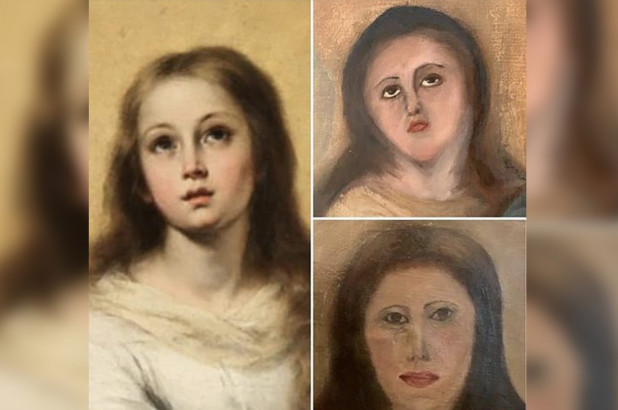
Here’s a rundown for those of you who care more for this situation than to say, “wow, that looks really funny and I’m going to make a meme out of it on Twitter. Alright, moving on”:
Bartolome Esteban Murillo (1617 – 1682) was a brilliant Spanish painter whose lifetime fell right in the thick of the Baroque period. As such, a majority of his work is heavily anchored in religious symbolism. “The Immaculate Conception of El Escorial” was finished around 1665 as just one iconic token of his storied career.1 Unfortunately, the piece would later fall prey to one of the art world’s ugliest sins: amateur restoration.
1It’s worth noting that the vast majority of outlets reporting this news aren’t even referring to the artwork by its correct name. This only throws more fuel into the fire to be discussed later on here.
While the original painting resides in Spain’s Museo del Prado, the irreparable damage likely was done to a (still valuable) copy. Copy or not, the greater glory of Art Movements Past is scarcely approached with the diligence or regard it deserves. Of course, most apathy comes from outside the art world; but it is also from outside the art world that funding and regulations are most apt to be provided. In other words, greater care for the greatest pieces must start with the general public.
A postmodern people means traditional techniques and themes have fallen out of favor for artists and viewers alike. (However, the “traditional-versus-postmodern art” debate is for some other post, some other day.) You can say what you will about “old art”, and agree to disagree on the motifs it so often brings with it. But you are lying to yourself if you say the Baroque era wasn’t one of our better moments as a species, and maybe – just maybe – we can commission someone better than a furniture repairman to put his hands on a valuable painting.
We can also do better than to look at any old masterpiece, which must have taken years of painstaking precision, and say, “hm, I can do that,” as was the demise of Ecce Homo in 2012. In this case, an original fresco by Elias Garcia Martinez was destroyed beyond imagination when a parishioner decided she would fix it herself.

Both works by Murillo and Martinez were botched in Spain. Whether this is a “Spain problem” is hardly the matter – the tragedy lies in the global reaction to both incidents. Ecce Homo’s downgrade was made into t-shirts, mugs, and keychains; the public rather celebrated a “funny looking face” than aided any calls for regulation. Just as well, the news of Murillo’s work being tarnished was met with an onslaught of memes, and was subsequently forgotten the day after. The bearers of the bad news (i.e. major networks and websites) added insult to injury by confusing the piece in question with another one of Murillo’s renditions of Mary. With so little concern to get the story straight – or take it seriously – how can we expect our core outlets to the general public to advocate for reform?
It often takes “incidents” such as these to enact change; and too commonly, the change is delivered in small increments. We can only hope this botched Mary didn’t get her fifteen minutes in vain.
 Present Preservation