British architect Karl Singporewala writes his take for Architects’ Journal: “Replicating Notre-Dame’s spire is wrong.”
We all watched in horror when Notre-Dame burned last spring. We saw the bright blaze tear through her center and force panicked plumes of smoke every direction – they’re tragic images one can scarcely forget in a lifetime. The embers finally cooled after a day’s destruction, and questions for “what’s next” naturally abounded thereafter. Notre-Dame has to be restored; and leading figures in the world of architecture, fine arts, legislation, and just about everywhere else were suddenly embroiled in debate over what exactly this restoration would mean.
French president Emmanuel Macron and former prime minister Edouard Philippe had the idea to hold an international competition to design a new, modernized spire for Notre-Dame. Such an idea was met with mixed reviews from the cathedral’s present stewards as well as the general public – one of the most passionate opponents being chief architect Philippe Villeneuve. Villeneuve rightly sees Notre-Dame as a symbol for French artistry, history, and heritage; and it’s the sum of every last artistic part which makes this cathedral the icon it is today. Why, then, would we tamper with this image?
But Jean-Louis Georgelin, speaking for Notre-Dame’s reconstruction on behalf of President Macron, unkindly told Villeneuve to “shut his mouth” on the matter.
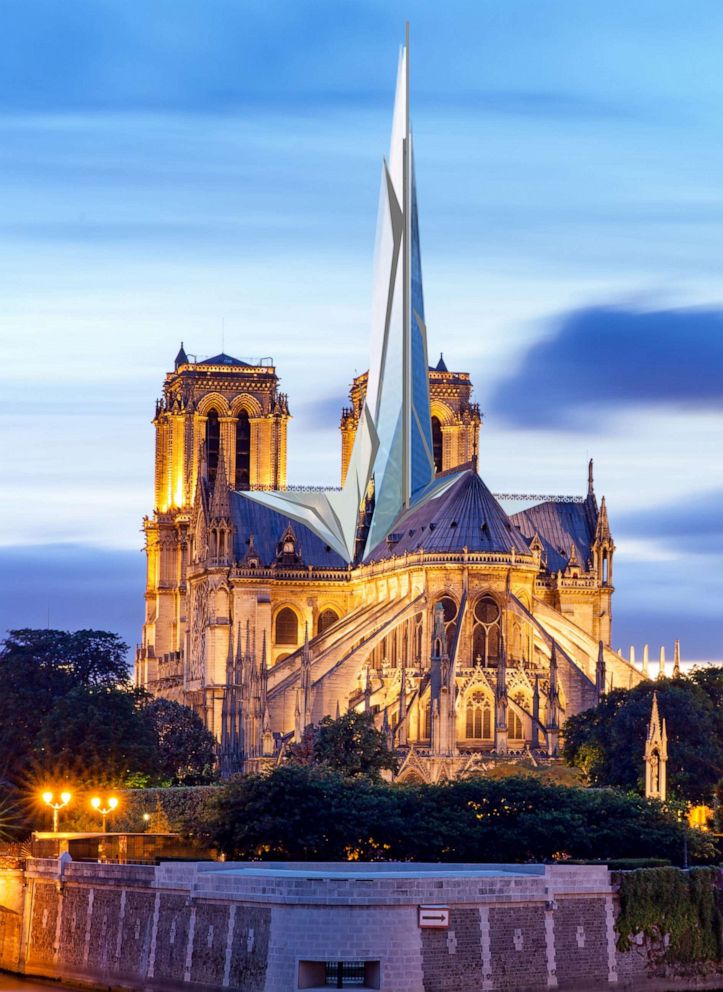
With that, it’s safe to say some leading figures in France did not want to restore Notre-Dame exactly as it was – why they felt that way, however, is another matter up for debate. But experts, journalists, and the like – French and abroad – are making their case for modernization heard. Karl Singporewala is one of these contributors, and he sees replicating the spire as backwards-thinking and a “missed opportunity”.
“There is a difference between preservation and replication,” writes Singporewala, elaborating further: “Preservation, by its very definition, requires something that needs protecting – but in this case, the spire was destroyed in its entirety.”
So, there’s a lot to unpack here.
Preservation is a driving life force in the arts; it is a two-pronged stewardship both to the object itself and its lasting memory. Contrary to this, Karl Singporewala’s camp for modernization implies that preservation is a cut-and-dry duty strictly to the physical object; whatever is destroyed is a lost cause which, as fate would have it, is simply meant to be left behind.
But preservation and replication are not so far apart as critics like Singporewala argue. Oftentimes, preservation actually necessitates replication, and the intentions for both assimilate into one singular act of stewardship.
How would we preserve paintings without mimicking the original artist’s colors, brush strokes, techniques, and craftsmanship? And in consequence of this due diligence, the themes of the artwork (i.e. the exact message of the artist) are kept intact as well. A halo remains visible and golden; a subject’s eyes continue to express emotion as intended. In these contexts, replication is a vital avenue of preservation. It’s tragically shortsighted, then, to liken replication to merely photocopying something, or building a scale model, and calling it a day. It is exactly this thousand-yard squint at what replication means – and this defeatist voice – which Singporewala employs to argue his point. In essence, we shouldn’t care how or why the spire looked the way it did – it’s already destroyed.
Such a sentiment entirely discounts the fact that Notre-Dame truly is an architectural work of art which – fire or no fire – should stand on this Earth exactly as it was intended to.
There are a thousand other reasons not to “modernize” the Notre-Dame’s architecture. Five hundred of these reasons would come from the architectural wheelhouse (aesthetics, uniformity, et cetera); and you can hear the other five hundred reasons from “heritage zealots,” as Singporewala calls anyone who says, “maybe we shouldn’t be so quick to let go of the masterpiece that was Notre-Dame’s iconic spire”.
Simply put: a modern spire looks ridiculous, and it blatantly spits on the cathedral’s historical integrity – or, its “heritage,” as some might be crazy enough to call it.

Now, are these hyper-modernized spires a bit extreme? Absolutely, and Singporewala recognizes this – and he even assigned blame to these images when the French senate ultimately decided not to modernize the structure.
“These ill-considered designs were then splashed over social media and used as clickbait by a number of media outlets, in the months following the fire, giving the heritage guys all the ammunition they needed to enforce a decision to replicate the spire as the only ‘sensible’ option for Paris, ” he writes.
I hate to tell you this, Karl – but those “heritage guys” already had the scholarship and experience they needed in order to feel like reinventing Notre-Dame in 2020 was a bad idea. Their minds were made up. They were never going to want a new spire. That’s the caveat to being “heritage guys” – they believe cultural icons are best preserved and displayed as they were originally intended to be preserved and displayed.
“I mean honestly, why don’t we just burn down the whole cathedral while we’re at it? The spire, as it was, is dead and buried. Wait, wait hold on… you’re telling me there’s an incentive to preserving historical structures? And the spire, being part of this cultural icon, should be dignified as such?” – some intern at an Architects’ Journal party, at some point, probably.
It’s still unfortunate that a case ever had to be made for putting the Notre-Dame back together as it was. However, there exists a very real – and growing – subset of professionals who see really any form of tradition as narrow-minded. Macron’s idea to hold a competition to redesign the spire was merely an evasive way of saying “I want to modernize this thing so bad, and you should want it too.” After all, if a contest is what reinvents Notre-Dame, who would the French president be to stand in the way of the people?
So consider this a thank-you to all those involved who put up the important fight for Notre-Dame’s legacy – especially Philippe Villeneuve. It’s those who stand for preservation who allow our most treasured relics to survive as intended.
 Present Preservation